Creating knowledge and understanding through science equips us to find solutions to today’s acute economic, social and environmental challenges and to achieving sustainable development and greener societies. As no one country can achieve sustainable development alone, international scientific cooperation contributes, not only to scientific knowledge but also to building peace.
Science policies are not enough. Science and engineering education at all levels and research capacity need to be built to allow countries to develop their own solutions to their specific problems and to play their part in the international scientific and technological arena.
Linking science to society, public understanding of science and the participation of citizens in science are essential to creating societies where people have the necessary knowledge to make professional, personal and political choices, and to participate in the stimulating world of discovery. Indigenous knowledge systems developed with long and close interaction with nature, complement knowledge systems based on modern science. Science and technology empower societies and citizens but also involve ethical choices.
Countries need to have the scientific, technological and engineering capacity to provide solutions to the sustainable development challenges they face in areas such as health, agriculture, communication, energy and industrial and infrastructure development. They must not only invest in good national science policies and governance systems but also in building capacity to carry out scientific research which means excellent science education at all levels, effective engineering education and quality universities and research centres. Scientific capacity and know-how whether resulting from local and national research or imported through technology transfer is critical in being able to develop and choose appropriate solutions to today’s multiple sustainable development challenges.
Capacity in engineering, using science and technology to develop useful products and services, is critical to finding appropriate solutions particularly in Africa, where there is an acute shortage of engineers. In particular, engineering curricula need to be more focused on finding sustainable solutions for example in the field of transport, and to attract young talent in particular young women into careers in engineering.
Discovering and developing sources of renewable energy is one of the keys to sustainable development. Building capacity to develop national renewable energy policies and know how in renewable energy technology is essential to create sustainable and thriving societies.
Creating scientific networks and facilitating access to scientific information are of great importance to building strong scientific research bases integrated into the international scientific communities. Here, the use of information and communication technologies is increasingly important.
What we must do
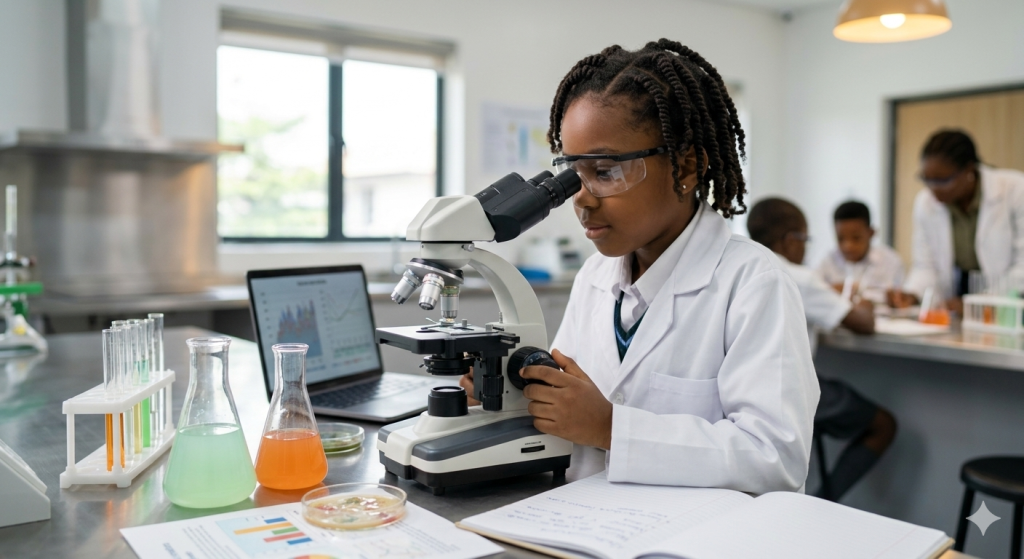
- We must sponsor, organize and coordinate STEM clubs in schools starting from Elementary to Secondary schools in order to get children interested in the field of Science, Technology, Engineering and Mathematics.
- Introduction of computer science and coding in schools and after school programs.
- Sponsor, organize, and coordinate summer STEM camps for boys and girls ages 4 through 18.
- Providing youth with opportunities to advance their interests in science, technology, engineering and mathematics, through organizing of worskshops, science competitions, awarding of scholarships to pursue fields relating to STEM at the tertiary level of Education.
- Providing qualitative trainings to Elementary and Secondary school teachers in the area of STEM development.
- Historically, women have been significantly underrepresented in engineering fields, typically making up only 10 – 20% of the engineering work force. We develop and pursue programs that encourage women to pursue engineering studies and retain women engineers in the profession.
- Seek out internship, mentoring programs for the youths in STEM with companies involved in Research and Development, Science, Engineering and Technology.
- Create and establish partnership with Corporations, Universities, Foundations, Inter Government Agencies to facilitate interest in STEM